In my twenties, I was once with my sister at her then-brand-new (and soon-to-be-ex) boyfriend’s car. She’s a bit older than me, and he was older than both of us. His name? Ornan. One letter away from Onan—that’s Hebrew for, He Who Masturbates. Not a single person in his presence ever forgot it. His parents’ originality on full display every time he introduced himself.
When we met, I tried not to laugh—for my sister’s sake. We climbed into his convertible. He was small, chest puffed out, and he spoke in that voice—deep, self-important, half-Kermit, half-gravitas. You know the one. It starts with a little throat clear: chchchch. And then again: chchchch.
“I need to call my secretary,” he announced. Yes—secretary. Even in the ‘90s, it sounded outdated. Then: “I’ll just put her on the Diburit”—Hebrew for the car speakerphone back then.
And then came the voice of his poor ‘secretary,’ as he delivered his important command: “Sell the stock.”
I looked over at my sister in the backseat like—are you fucking kidding me? Are you seriously expecting me not to laugh at this? Her face was priceless—her eyes laughing, her mouth doing acrobatics not to betray a smile. It was the unmistakable “please don’t” face. And I honored it. Because we both knew—knew—that if even one of us allowed the tiniest curve of a lip, we’d be gone. We’d sit there like two schoolgirls in the backseat, helpless, tears running down our faces, convulsing with laughter we couldn’t stop. And that poor schmuck, gifted a joke name at birth, would know exactly who he was in that moment: not our driver, not a man of great stock-selling authority—just the punchline.
To this day, all it takes is a throat clear, and my sister knows I’m about to ask to speak on Diburit.
Diburit, which translates loosely to a feminine version of “Speaking One”, struck a chord with me. Why? It took me years to find out. At first, it was just that—the joke of that obvious alter ego we see in someone else. The caricature of themselves they show to the world. It made me laugh at ‘other people’ trying to be someone they are not. It stuck itself in the crevices of my mind, and didn’t let go for years, and let’s be honest, that story is funny, but not so many years after funny. So what was it? Why did that word not let go? These are the curiosities I hold in my mind all the time, tiny little mysteries waiting to unfold.
It was not until many years later, the river that flew between 2023 and 2025, that Diburit made a comeback from the 1990s, this time as a tool to name something I was noticing, so I could notice it more clearly—you know how when we name something it comes to life?
Years ago I was at a crossroads at work, and I reached out to my cousin, my very zen younger cousin, who recommended I read The Four Agreements. When I read the intro I almost put the book down—it was so out there. But this was his advice, to read the book. I asked for it. So at least I had to be curious enough to read it. Yes, I forced myself past the intro, and met a book that has changed the course of my life. This profound book trickled in, drip by drip, penetrating me by allowing me to put a different lens on my eye, like prescription glasses, both distorting and clarifying the world around me.
It introduced me to the idea that we actually live in a silent world, one that we fill with words – the tools that we use to communicate what is on our inside – ever so clumsily.
It pointed out, for the first time in my life, that there is a constant talking in my head, the narrator, as Don Miguel Ruiz calls it in his book, the voice of knowledge. But mine—her name is Diburit.
It was when I realized that the voice in my head—the constant stream of thoughts—was not me, that I started to move into a different kind of space. A space between words, behind them, under them—a quiet space that felt both unfamiliar and yet deeply familiar. It was raw, unsettling, and refreshing in ways I didn’t even know I have been longing for.
But I didn’t just go there. I was shaken and pushed by my son’s words, and that’s what moved me to go into this unknown space. He did it for me – called me from afar, served as a radar – for me to start hearing the echoes inside the static of the fog.
I was in a relationship. We were already living together. There was a time, a little north of a year ago, that I felt I was out at sea. Someone else was residing in my body. Who that was, I didn’t know. I just remember, in a fog, realizing that this is not me. A version of me, no doubt—someone who was so off center.
And here’s the thing about being so off center: the more off you are, the less you even remember that a center exists. It becomes just a nice word we say, a far away concept that ‘spritual’ people use, and somehow has entered our vernacular. But as I was drifting from it, I couldn’t even recall what it felt like. Not really.
I remember sometimes coming back from work, standing in the kitchen making dinner, hearing the noise of my life—my kids, my then-boyfriend helping me make dinner—and wondering, where was I – where have I gone? That was a constant quiet aching in the background, one I was both actively drowning and also trying to hear.
On the surface, I was happy. So happy. I was so in love… except for a small detail:
I actually wasn’t.
I’d wake up every morning, and I didn’t know what had happened to me. I used to wake up happy each morning—I swear—even when I was married and unhappy in my marriage. I’d wake up with this feeling of freshness, eyes open to a new day, a sense of wonderment… I don’t know, my first few minutes in the morning were usually good. But not when I was in this relationship, living together. Not when I’d wake up next to him.
Something odd happened. I’d still wake up to that same initial feeling—but then I’d feel something in my throat, almost like it was sliding down into my chest. A tingly feeling. What is it—anxiety? Angst? Fear? I can’t name it, but it wasn’t pleasant. I had never known it before. It would spread through my chest, and then settle in my stomach for the rest of the day.
I didn’t realize it at the time. I couldn’t understand it. But I was waking up each morning to a type of darkness I had not known before. And the thing is, I was so off center that even when my body was screaming that something was wrong, I just jumped out of bed for another day in the dark.
Lucky for me, someone dared to wake me up. Someone dared to say to me, “Ema”—that’s “mom” in Hebrew, and it always calls me to attention. “Ema, you are not the same.” And I assure you, it wasn’t a “you’re so much better.” It was an “Ema, where the fuck are you? Where have you gone?”
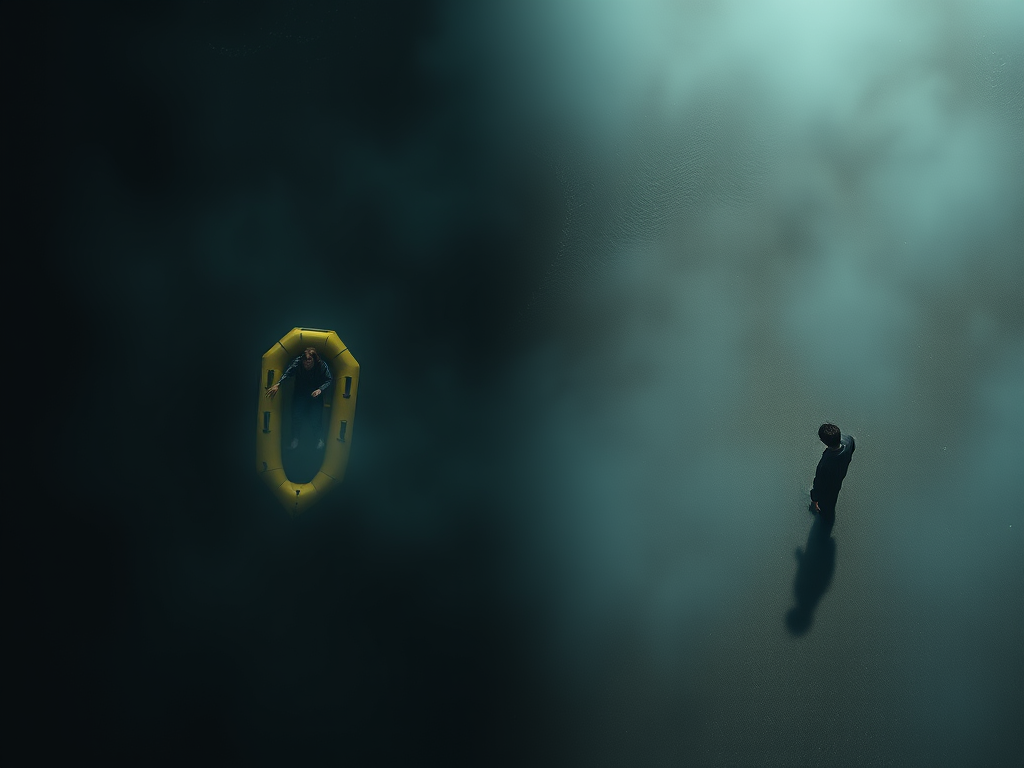
It was my son, standing on the shore, looking at me lost at sea, shouting SOS—Ema. Wake the fuck up—like only he can. A certain magic that he holds, sharp words that cut through the fog, and soft love than can land in your heart so tenderly. He looked me straight in the eyes, not flinching, him right there, in his eyes, inviting, loving, warm, fearful, concerned, stable, and me hiding behind mine. Called out. “Ema, you are not the same.”
Wouldn’t it be nice if the story was that he said that and I woke up, like “Yes, you’re right…”? But unfortunately, as my body screamed at me in my own haze, when my son was blowing the foghorn, all I could do was start hearing its echoes. My knee-jerk reaction was to tell him that he’d just never seen me happy. Diburit started screaming in my head—she was terrified that I might see through the fog, through a relationship manufactured so carefully of gaslighting.
But “Ema, you are not the same” was the antidote to Diburit, because his voice began to talk back.
A thousand thank yous to my anchor, the one on shore who dared to speak truth to me. A thousand thank yous to my three kids who ground me in reality, even when I’m lost at sea.
It was not the first time he gave me a breath of life as I was dying inside my own skin.
I got separated in January 2020, and we all know what happened in March 2020—global pandemic. As I burst the bubble of the illusion of my marriage, allowing myself to fall into a black hole of not knowing, of fear, I had no clue that in just two months, we would all turn into zombies. Do you remember those days? The duality of being zombies in our own lives, while still feeling so human in our longing for each other—the thing we seem to enjoy in being around all of us, annoying as we are?
It was during that time that I all but forgot how to smile. Of course, I could still move the corners of my lips upward, but not the kind that touches your heart—that wasn’t there. Laugh? I live with some of the funniest humans on earth, but I just didn’t laugh. I fell into a gaping hole so deep inside myself, I don’t know where I was after my marriage ended.
We went to the supermarket—those long lines, remember? My son came with me. We were going through the dairy aisle, and I was reaching for some milk, minding my own business, when he grabbed the eggs, just adjacent to me. You know that silent dance you do in the supermarket? As I reached for the milk, someone behind it said something. Fuck, I jumped. Jolted into life.
But my son? He would never let a moment like this pass without his brilliant commentary. His mischievous eyes lit up—just that alone can brighten my day. That look in his eyes, with a hint of a smirk, told me everything. He noticed the joy the man behind the milk took in saying it just loud enough to scare me, and just “innocent” enough to not seem like he tried. He said his “sorry” so artificially, that all three of us knew he was grinning in success behind the curtain of milk.
My son picked up on all of that without words and said to me, “I bet he enjoys scaring kids at the park.” And I can’t tell you how much I laughed at that. People had to turn and look because I had forgotten how to laugh for three months. That comment cracked me open to the point where my knees went soft from laughter.
To my son, who sees me when I’m asleep at the wheel and finds the way to say, Ema, wake up, reminding me that I’m still alive. Who dared to say it straight to my face: Ema, you are not the same. Despite what I was telling myself at the time, despite diburit screaming on and on, those words—Ema, you are not the same—kept echoing in my mind.
Ema, you are not the same. I dared to face it. I dared to shut down Diburit, the voice that screamed, You are happy, you are happy—the one telling me not to listen to him. It wasn’t until I was willing to talk back to her that I was allowed to look. Where? In the fucking mirror—that’s where.
I was afraid to look.
No, not just metaphorically. I looked fine at the time, I think. But truthfully, I reached the point where I couldn’t look at myself in the mirror. I was a fake. A hollow shadow of who I was supposed to be. Someone else was embodying my skin, and I couldn’t face it. Just quick glances to make sure I looked ‘good enough’ for the world to see.
But he didn’t let me. It took months for that echo to ripple through my brain. For me to dare to ask myself, Why do I not feel the same to him? Is it possible that his concern, the fear in his eyes, was valid?
I dared to examine it. Do you know why? Because what other choice did I have? I brought these children into the world, I owe them to show up as me for them—the best version of me. So, I had no choice -I had to be real, I just had to wake up.
That statement began to ripple through my mind in a series of questions and answers, and I didn’t like the answers I was getting. So I kept turning away, refusing to face them, but fuck—they were all around me.
I wanted to share this with my boyfriend, you know, the other adult I was with. But I couldn’t. Why? Because in reality, he wasn’t an adult, and I knew he’d personalize it, make it all about himself. That distance between us made me wonder—Why isn’t he mature enough to be someone I can talk to freely?
And then, I dared to ask myself another question: Is this what I want?
I started noticing, moment by moment. Not the story I told about the moments. Not Diburit narrating my every move. But the actual feeling inhabiting my body as I lived in this haze. I did this experiment, asking myself throughout the day, How am I feeling right now? And many times, the answer was: Bored.
Fuck.
Seriously, is it possible that he’s boring?
Yes. Fucking yes.
Turn around, don’t look. But there was another question, sparkling from the dark: Ema, where are you? Why are you not the same?
And then came the day I saw the heartbreak in my kids’ eyes. It was like a slingshot to the rosy sunglasses I’d been wearing for so long, blinding me to everything.
He took a call during dinner, while he was living with us, from what was effectively his wife—separated, yes, but still calling because she needed his help. And my kids looked at me, sitting next to this weak man, actively being humiliated by him. Stepping once again to a smaller version of myself, like one of those babushka dolls, disappearing into a box within a box. Now, I was supposed to step into one right in front of my kids? The “other woman” box. Right here?
Ema, where the fuck are you? The strong one? Is this who you’ve become? In the name of what? For the love of God, please don’t tell me it’s in the name of love. They knew it better than me – this is not what love is supposed to feel like.
I was living in parallel worlds: the one where it was “okay”—you know, he was still on “good terms” with her, that one where I was the issue because I wasn’t patient enough—and the other reality, the one where this man, living for free in my house, a wealthy man, was taking advantage of me. A woman raising three kids on a single income in California. A woman who had to reinvent herself after spending 10 years raising children.
He was living here for free, playing house with me and my kids. Enjoying the warmth and livness of my family. And in the meantime, using me and my family up. My kids knew it. I was the only blind one. But as they slouched over, leaving the dinner table because his sweet voice with his perpetual almost-ex-wife was too much for them to bear, they sat empty on the couch. And I saw myself in their eyes.
Ema, where the fuck are you?
He gave me a gift on my 48th birthday—the best one he had ever given me. A real one.
By that time, the echo of my son’s question was already magnified in my brain. I had asked and answered so many questions that my reality split in two. I was constantly trying to discern between these competing narratives, spinning in place, arguing an endless argument in my head—turning it over and over until it occupied almost all of my mental space.
On the surface, I was in a good relationship. We used to laugh together like I’ve never laughed in my life. There were things that were good—really good, even. I can’t deny that.
But then came my birthday. We were sitting with my kids, and he gave me a gift—from him and the kids. An Apple Watch. It was clear it was my oldest’s idea, and that she’d reached out to him. I was touched.
But then we got into the bedroom, and he said it. He told me not all three kids gave him money for the watch, and that he had to pay more than his fair share of the $400.
And the internal dialog kicked in immediately.
Why was he telling me this?
Either buy me the gift or don’t, but why ruin it by letting me know who didn’t pay?
Wait—he made my kids pay for this? With their own money?
Seriously? He couldn’t just cover it and say it was from all of them?
And what did he want from me in that moment—was I supposed to be mad at my kids?
Was I supposed to think that one of them didn’t love me as much as I thought?
Or was this about him? Was I supposed to see how generous he was?
All of that ran through my mind in seconds.
And while it did, his whole energy changed. The lightness from dinner was gone. In its place was that heaviness I knew too well—the version of him that only came out when no one else was looking.
I said, “Not today. Not on my birthday.”
I told him I didn’t want to go to sleep like that.
But he didn’t care.
And that was the truth.
I went to sleep that night staring straight at it.
The next morning, something happened.
I woke up. Eyes wide open.
Literally. Metaphorically. Finally.
I turned to him in bed, and that yucky feeling—the one that used to enter my body the right after I oriented myself, after I opened my eyes—I suddenly saw it for what it was. His energy. Not mine.
And I didn’t let it in.
I looked at him. Really looked.
And for the first time in years, I saw who I was with.
And in that moment, I knew.
I had no other choice.
I had to leave.
It took time to work up the courage. My body felt weak every time I thought about it. Not because I was letting go of a person who didn’t treat me well. No. Because I was letting go of myself, a version of me that I had to admit didn’t work. And I knew I would be left hallow of myself, letting go of a comfort that was stabbing me from the inside.
I wish I could give you the Hollywood ending we have all gotten so accustomed to. Sign off with some smart conclusion, a promise of a promise, the sparkly gold at the end of a rainbow. But alas, that is not where I am. I’m here in the mess. In the words. Behind them. Between them, and under them – Echoing to you from across the screen, saying to you Hineni – here I am.
And as I close the curtain of this piece, I bow down to you. Right Here – the here where you and I meet, this platform, my soul meeting your eyes, and maybe more. In gratitude for allowing me the space, for holding my hand reaching out through these words. Thank you.
Ema, Where The Fuck Are you?
– I’m coming home!
 KerenOr
Leave a comment